Why Does My Child Know English Words but Struggle to Make Sentences?
 Gunika Shah5 Sept, 2026
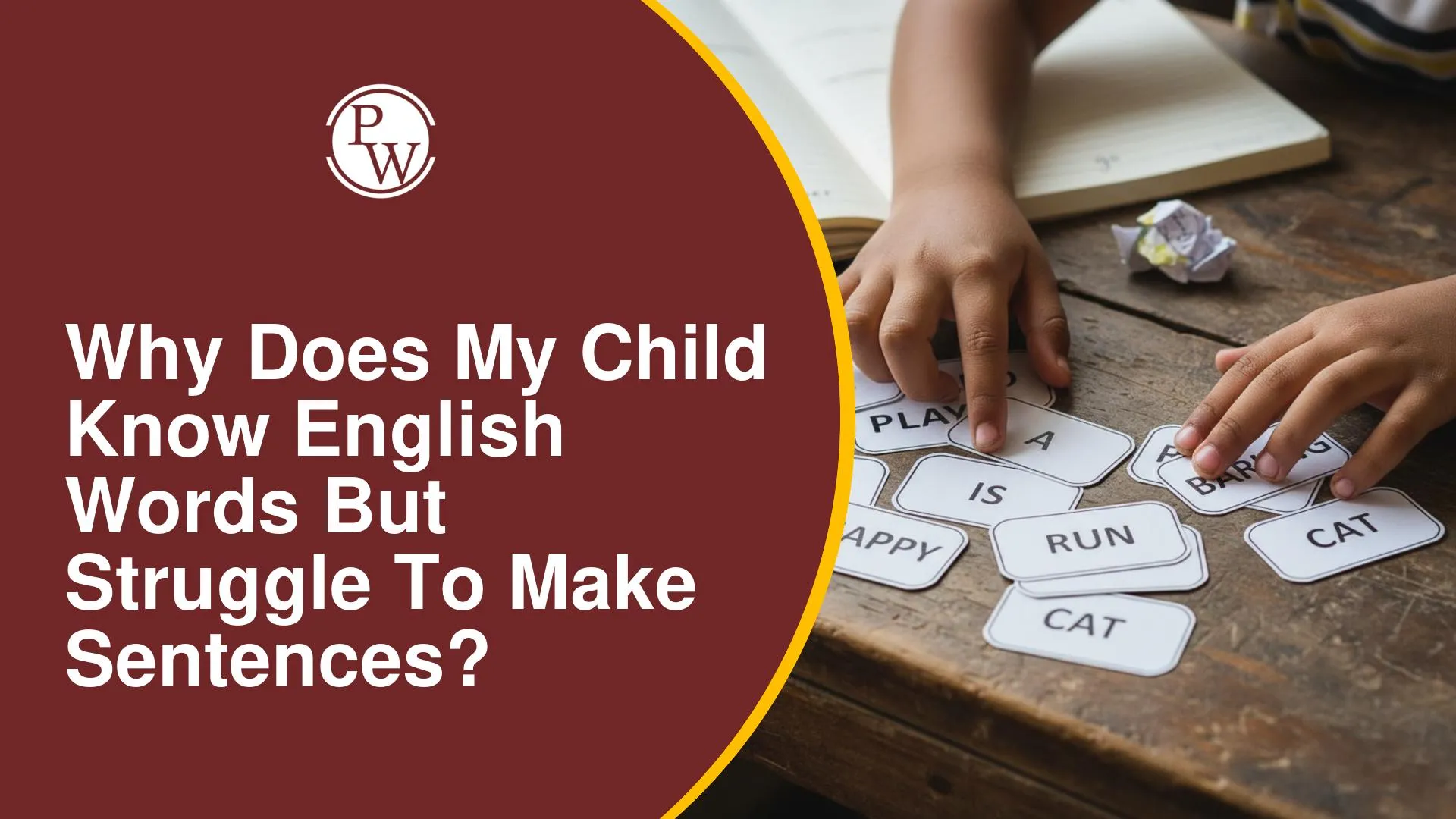
Your child may know many English words but still hesitate when asked to speak in complete sentences. They may give short answers, mix up word order, or struggle to express an idea even when they know the vocabulary.
This is because knowing words and using them in communication are different skills. Regular Listening, Speaking, Writing, and Reading (LSWR) practice can help children understand how words fit together. CuriousJr’s English by Cambridge course supports this through live classes and teacher interaction, helping children gradually use familiar vocabulary to form meaningful sentences with greater confidence.
Why Knowing English Words Is Not Enough to Make Sentences
Knowing the meaning of a word is only one part of communication. Your child also needs to understand where and how that word can be used.
For example, knowing the words “boy,” “ball,” “play,” and “park” does not automatically mean your child can say, “The boy is playing with a ball in the park.”
Here is the difference:
|
What Your Child Can Do |
What It Shows |
|
Recognises “hungry” |
Understands vocabulary |
|
Says “I am hungry” |
Uses vocabulary in a sentence |
|
Understands “play” |
Knows the meaning of the word |
|
Says “I want to play outside” |
Uses the word according to the situation |
|
Recognises “yesterday” |
Has passive vocabulary |
|
Says “Yesterday, I went to school” |
Combines vocabulary and sentence structure |
Your child therefore needs practice in using familiar words together, not just memorising more words.
What Makes English Sentence Formation Difficult for Kids?
If your child knows vocabulary but cannot easily form sentences, look at the skill behind the difficulty.
|
Possible Difficulty |
What You May Notice |
|
Word order |
Your child knows the words but puts them in the wrong sequence. |
|
Grammar |
They struggle with verbs, tenses, articles, or prepositions. |
|
Sentence structure |
They start a sentence but find it difficult to complete the thought. |
|
Word selection |
They recognise a word but cannot recall it while speaking. |
|
Limited listening exposure |
They have not heard enough examples of how words naturally fit together. |
|
Limited speaking practice |
They understand English but rarely get opportunities to respond in complete sentences. |
These English speaking problems in children cannot always be addressed by teaching additional vocabulary. Your child needs to repeatedly hear and use words in meaningful sentences.
How Can Listening, Speaking, Writing and Reading Help?
Sentence formation becomes easier when your child experiences English in different ways. Listening provides examples, speaking gives them a chance to use those examples, writing slows the process down so they can organise their thoughts, and reading shows how sentences are formed in context.
-
Listening
Listening helps your child notice how words naturally come together.
You can:
-
Read short stories aloud.
-
Have simple conversations in English.
-
Ask your child to listen and repeat short sentences.
-
Use familiar words in different sentences.
-
Encourage them to notice how questions and answers are formed.
Instead of teaching only “water,” for example, let your child hear:
“Can I have some water?”
“The water is cold.”
“Please drink some water.”
-
Speaking
Your child needs opportunities to turn vocabulary into actual communication.
Try activities such as:
-
Describing a picture.
-
Talking about what happened at school.
-
Explaining how to play a favourite game.
-
Describing a favourite toy.
-
Answering questions in complete sentences.
-
Retelling a short story in their own words.
If your child says “Dog running,” you can model “The dog is running.” Later, you can expand it to “The brown dog is running in the park.”
-
Writing
Writing gives your child more time to arrange words correctly.
You can ask them to:
-
Rearrange jumbled words into a sentence.
-
Complete an unfinished sentence.
-
Write two sentences about a picture.
-
Write three sentences about their day.
-
Use a new word in a sentence.
-
Turn a one-word response into a complete sentence.
For example:
Jumbled words: park / went / I / the / to
Sentence: I went to the park.
-
Reading
Reading regularly exposes your child to complete sentences and shows them how familiar vocabulary is used in context.
Encourage your child to:
-
Read short age-appropriate stories.
-
Notice repeated sentence patterns.
-
Identify unfamiliar words through context.
-
Retell what they have read.
-
Describe a character or event in their own words.
-
Predict what might happen next using a complete sentence.
What Can Parents Do to Improve English Sentence Formation at Home?
You do not need long English lessons at home. Instead, make sentence practice part of activities your child already does.
-
Expand one-word answers: If your child says “apple,” encourage “I want an apple.”
-
Use sentence starters: Try “I like…,” “I can…,” “Today I…,” “I want…” and “My favourite…”
-
Ask questions that need sentences: Instead of “Did you like the story?”, ask “What did you like about the story?”
-
Practise familiar vocabulary: Ask your child to make two or three different sentences using a word they already know.
-
Model sentences naturally: If your child makes a mistake, repeat the idea correctly rather than stopping the conversation for every error.
-
Connect English with daily routines: Meals, playtime, shopping, travelling, and bedtime can all provide opportunities for short conversations.
-
Focus on regularity: A few sentences every day can be more manageable than occasional long practice sessions.
The purpose is to help your child become comfortable using English to express an idea, rather than making every sentence grammatically perfect from the beginning.
How Can CuriousJr Help Your Child Form Better English Sentences?
Through live classes and teacher interaction, your child gets opportunities to use English rather than only memorise vocabulary. Here is how each part of the LSWR approach can support sentence formation:
-
Listening Builds Familiarity With Complete Sentences
Your child hears how words are naturally arranged in complete sentences, helping them become familiar with word order, sentence patterns, and everyday expressions.
-
Speaking Turns Known Words Into Communication
Speaking activities encourage your child to recall familiar vocabulary and combine words into meaningful sentences while answering questions or participating in conversations.
-
Writing Strengthens Sentence Construction
Writing gives your child time to organise their thoughts, choose suitable words, and practise forming complete sentences with clearer structure.
-
Reading Shows Vocabulary in Context
Reading exposes your child to different sentence patterns and shows how familiar and new words are used naturally within sentences rather than in isolation.
-
Teacher Interaction Provides Practice and Guidance
During live classes, teacher interaction gives your child opportunities to respond, speak, practise sentence formation, and receive guidance as they develop their English communication skills.
Knowing English words is only the first step; children also need regular practice using them in sentences. Listening, Speaking, Writing, and Reading (LSWR) can help build this ability. CuriousJr’s English by Cambridge course supports this practice through live classes and teacher interaction, helping children communicate in English with greater confidence.
FAQs
1. Why does my child know English words but cannot make sentences?
2. How can I help my child improve English sentence formation at home?
3. Should my child focus on vocabulary or speaking practice?
4. How can English speaking classes for kids help with sentence formation?





Get Free Counselling Today
and Clear up all your Doubts
 Live & recorded classes available at easeDashboard for progress trackingLakhs of practice questions