Pentagon Definition, Properties and Example
 Nikita Aggarwal20 Jan, 2026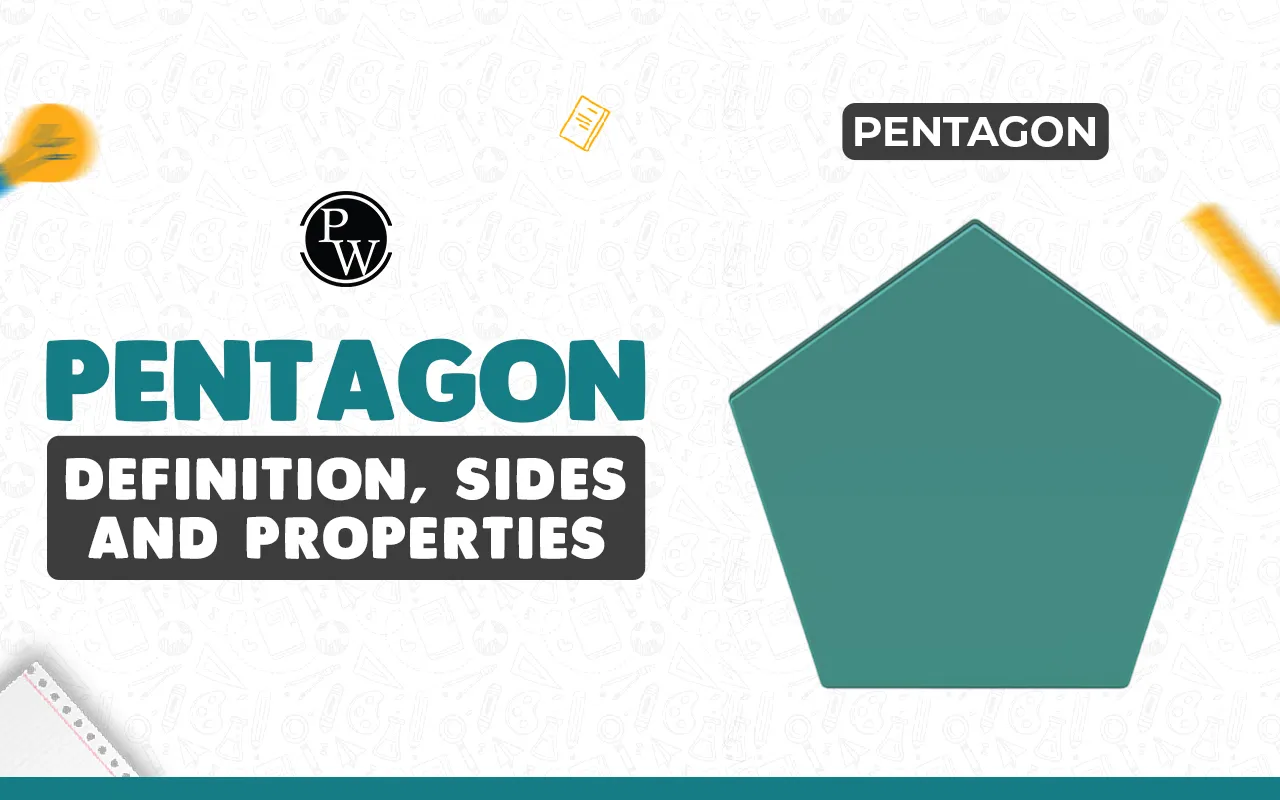
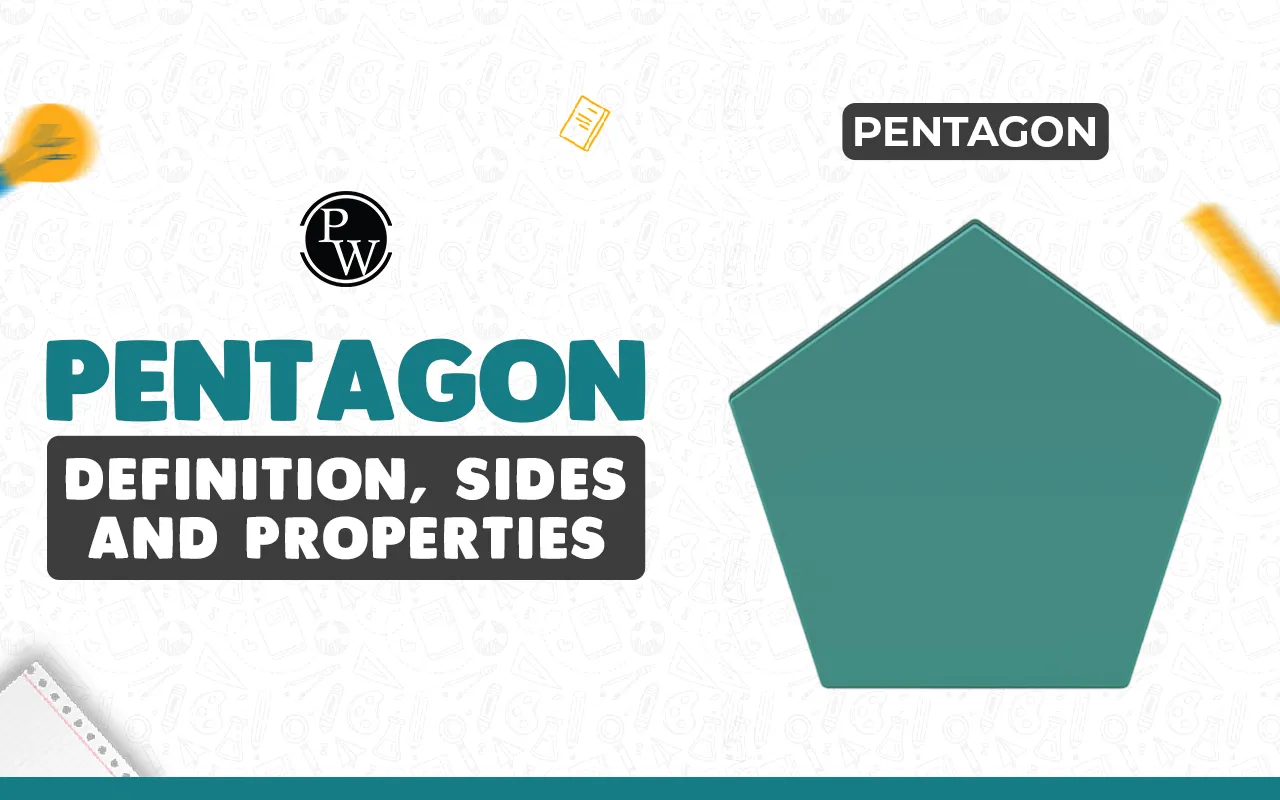
A pentagon is a geometric shape with five straight sides and five angles. In both regular and irregular pentagons, the total of all interior angles always adds up to 540 degrees. Regular pentagons have all sides and angles equal, while irregular ones have different lengths and angles. Pentagons can be found in many places like architecture, sports, and nature, making them interesting and practical shapes to study. This article explains the definition, properties, and examples of pentagons in simple terms.
Pentagon
Pentagon is a polygon with five sides. All the five sides connect to form the closed two-dimensional figure. The term ‘Pentagon’ comes from the Greek words penta (meaning five) and gon (meaning angle). Thus, a pentagon refers to a 5-sided shape with five angles. The angles are formed where the sides meet each other at the vertices.
Define Pentagon
A pentagon is a two-dimensional geometric shape with five sides and five angles. The word “pentagon” comes from Greek, where “penta” means five and “gon” means angle. All pentagons have five edges connected end to end, forming a closed shape. The interior angles always add up to 540 degrees, which helps identify pentagons in math and real life.
What is the Pentagon?
Pentagon is a two-dimensional shape with five straight sides and five corners. Each corner is called an angle, and together they form a closed figure. A pentagon can be regular, where all sides and angles are the same, or irregular, where the lengths and angles are different.
In a regular pentagon, each angle measures 108 degrees, and the total of all the inside angles is always 540 degrees.
Pentagons are often seen in everyday places. Road signs, architectural patterns, tiles, and even natural forms like okra slices or starfish can show pentagon-like shapes. This five-sided figure is one of the more familiar polygons and can appear both in man-made objects and in nature.
Properties of Pentagon
A pentagon is a five-sided polygon with five straight sides and five angles. The sum of all the interior angles of a pentagon is always 540 degrees. In regular pentagons, all sides and angles are equal, while irregular pentagons have sides and angles of different lengths and measures. Pentagons can be convex, where all interior angles are less than 180 degrees, or concave, where one angle is more than 180 degrees. The pentagon shape is flat and two-dimensional.
Pentagon Shape Examples
Pentagons are common in everyday life and nature. Some examples include the U.S. Department of Defense building, home plate in baseball, and some sections of a soccer ball. In nature, the brittle sea star has a pentagon shape. Pentagons are also found in various art and architecture designs because of their unique five-sided structure. These examples show the pentagon’s presence beyond just geometry.
Pentagon Sides and Angles
The number of sides in a pentagon is five. These may be equal or unequal in length. A pentagon also has five angles, which are formed where two sides meet. The five angles may be equal to each other or of different values.
In a regular pentagon, all sides are equal, and all angles are also equal. In an irregular pentagon, the sides and angles vary from each other in dimensions and values.
Read more: Angles Parts, Definition, Types
Pentagon Properties
A pentagon has some distinct properties that make it different from other polygons. The pentagon properties are mentioned below:
-
A pentagon has five sides, five angles, and five vertices.
-
The sum of interior angles is 540°.
-
The sum of the exterior angles is 360°.
-
Each interior angle of a regular pentagon is 108°.
-
Each exterior angle of a regular pentagon is 72°.
Vertices of Pentagon
The vertices of a pentagon are the points where its five sides meet. Each pentagon has exactly five vertices or corners. These are important in measuring angles and understanding the pentagon’s shape. Vertices can help classify pentagons into different types by the angles formed at these points. The five vertices give the pentagon its distinct five-sided outline.
Pentagon in Maths
In mathematics, a pentagon is classified as a polygon with five sides. It is studied for its properties like side lengths, angles, and area. Math distinguishes between regular pentagons, where all sides and angles are equal, and irregular pentagons, which have varying side lengths and angles. Pentagons are useful in geometry, trigonometry, and area calculations.
Pentagon Formulas
The different parameters of a pentagon can be determined using respective pentagon formulas. Students often use these formulas to solve geometry problems involving pentagons.
Some of the most important pentagon formulas are given below:
Interior Angles of a Pentagon
The formula for finding the sum of interior angles of any polygon is
(n-2) x 180°, where n = number of sides of the polygon.
Therefore, the sum of interior angles of a regular pentagon is
(5 - 2) x 180° = 3 x 180° = 540°.
Therefore, in a regular pentagon with equal sides, each interior angle is 540°/5 = 108°.
Exterior Angles of a Pentagon
The sum of exterior angles of any polygon is always 360°.
So, for a regular pentagon with all equal angles, each external angle =
360°/5 = 72°.
Number of Diagonals in a Pentagon
The number of diagonals in a polygon can be obtained using the formula:
n x (n - 3)/2 where n = number of sides of the polygon.
So, the number of diagonals in a pentagon is: 5 x (5 - 3)/2 = 5 x 2/2 = 5.
So, a pentagon has 5 diagonals.
Perimeter of a Pentagon
The perimeter is the sum of all sides.
For a regular pentagon with all equal sides, the formula of the perimeter is:
P = 5 x a
where a = length of a side
For an irregular pentagon with different lengths of sides, the perimeter formula is:
P = a + b + c + d + e
Where a, b, c, d, and e, are the lengths of five sides of the pentagon.
Area of a Pentagon
The area of a regular polygon (all sides equal) is given by the formula as follows:
Area = ½ × Perimeter × Apothem
Where apothem is the distance from the center of the pentagon to the midpoint of a side.
Read more: Construction in Maths
Types of Pentagons
Pentagons can be classified into different types based on sides and angles. Here are the main types of pentagons:
Types of Pentagons Based on the Length of Sides
The pentagons can be categorized into two types depending on the dimensions of their sides, as mentioned below:
Regular Pentagon
-
All sides and all angles are equal.
-
All diagonals are equal.
-
Each interior angle = 108°.
-
Each exterior angle = 72°.
Irregular Pentagon
-
Sides and angles are not equal.
-
Diagonals are not equal.
-
No uniform symmetry in shape.
Types of Pentagons Based on the Length of Sides
Pentagons can also be classified into two types based on the nature of their angles and diagonals, as mentioned below:
Convex Pentagon
-
All interior angles are less than 180°.
-
The diagonals lie inside the figure.
Concave Pentagon
-
At least one interior angle is greater than 180°.
-
At least one diagonal lies outside the figure.
Read more: Vertex Formula
Solved Examples Using Pentagon Formulas
After getting a clear idea of what a pentagon is, and pentagon sides and angles, students need to practice solving problems using pentagon formulas.
The following examples based on pentagon formulas can help clarify the concepts better.
Example 1: Find the perimeter of a regular pentagon with each side equal to 7 cm.
Solution:
The formula for the perimeter of a regular pentagon is:
P = 5 x length of one side
So, the perimeter of the given pentagon is:
P = 5 x 7 = 35 cm.
Example 2: Find the area of a regular pentagon with a side length of 8 cm and an apothem of 5 cm.
Solution:
The perimeter of the pentagon is P = 5 × 8 cm = 40 cm.
Therefore, the area of the pentagon is A = ½ × 40 × 5 = 100 cm².
Example 3: In an irregular pentagon, the measurements of four interior angles are 135, 84, 116, and 95°, what is the measure of its fifth interior angle?
Solution:
The sum of interior angles of a pentagon is 540°.
So, the measure of the fifth angle of the pentagon is:
540 - (135+84 +116 + 95)
= 540 – 430
= 110
Answer: The fifth angle of the pentagon is 110°.
Also read: Area of Circle
Importance of Studying Pentagons
A conceptual clarity about pentagons can help students in various ways as follows:
-
Strengthen their understanding of different types of polygons.
-
Apply geometry to real-life applications like architecture and art.
-
Prepare for advanced topics involving geometrical shapes.
-
Develop problem-solving skills using pentagon formulas and apply the results in appropriate contexts.
Pentagon Shape Examples in Real Life
Pentagons are not just geometrical shapes that appear in textbooks; they have relevance in daily life, architecture, and nature. Here are some common pentagon-shaped examples:
-
Architecture: The headquarters of the U.S. Department of Defence is a world-famous structure designed as a regular pentagon.
-
Sports: The base plate of a baseball has the shape of a pentagon. The black panels of a soccer ball have the shape of regular pentagons.
-
Nature: Some flowers have pentagon-shaped arrangements of petals. Some vegetables show pentagon-shaped cross-sections.
The pentagon is a polygon shape with five sides and five angles. An understanding of pentagon types and properties, and applying pentagon formulas, can help students solve geometric problems with ease and confidence.
Boost Your Child’s Mental Maths with CuriousJr
Is your child still counting on fingers or taking too long to solve simple maths problems? CuriousJr offers online Mental Maths Classes that turn number practice into something enjoyable and effective.
Through interactive lessons filled with games, tricks, and easy-to-follow techniques, children learn how to solve problems quickly and with better focus.
Each class includes live teaching, individual guidance, help with homework, and regular progress checks. Your child receives personal attention and simple tools to improve their calculation speed and thinking skills over time.
Curious to know more? Book a demo class today and get started.
Pentagon FAQ
What is a cyclic pentagon?
What are the lines of symmetry of a regular pentagon?
What is the center of a regular pentagon?
How many internal angles of a pentagon can be right angles?