Confidence Test: Can Your Child Speak English? (Level Movers)
 Nivedita Dar12 May, 2026

Any parent knows it’s hard to watch a child struggling to find the proper words in a discussion. They know the rules of grammar from their textbooks, yet they often get stuck while they are speaking. That's the difference between knowing English and speaking it that a Level Movers assessment is meant to help you cross. A systematic English speaking test for kids will show you exactly what the “speaking blocks” are. It could be a lack of language or simply a little stage fright. Either way, knowing where they are at is the first step to help them speak effortlessly and effectively with the world.
What is an English Speaking Test for Kids?
At the Movers stage, children move beyond basic one-word answers. They begin to use full sentences and describe the world around them. An English speaking test at this level isn't about passing or failing; it is a spoken English assessment designed to see how well they can handle everyday interactions.
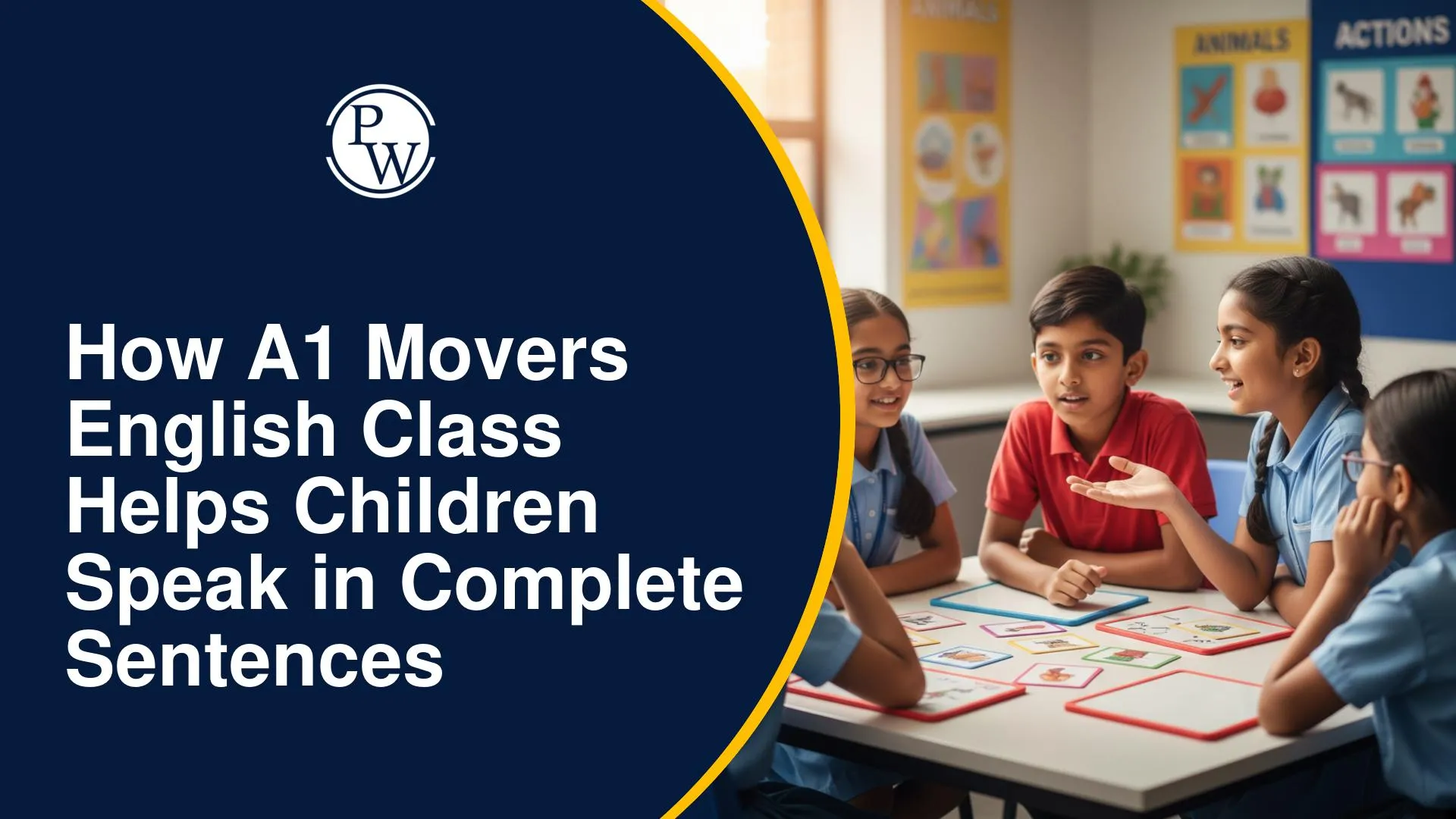
The test usually involves three or four short tasks. These tasks encourage the child to look at pictures, find differences, and talk about their own lives. It is a gentle way to measure how much they have progressed from the basic Starters level.
Importance of Confidence in a Spoken English Assessment
A child may know 500 words, but if they are frightened to make a mistake, they may only utilize ten. And that's why many parents are looking for a confidence test. If the youngster is 'safe' to make mistakes, fluency will improve swiftly. Formal assessment gives a baseline for students to see they can do it, boosting their morale for future learning.
Parts of a Spoken English Evaluation for Kids
When your child sits for an evaluation, the examiner looks for specific skills. It isn't just about "correct" English; it is about how they use the language to get their point across.
Spot the Differences
In this part of the English speaking test for kids, the child looks at two similar pictures. They must identify what is different.
-
Skill tested: Using descriptive adjectives (e.g., "In this picture, the ball is red, but in that one, it is blue").
-
Focus: Prepositions and basic sentence structure.
Picture Storytelling
The examiner shows a series of images that tell a story. The child needs to describe what is happening in each frame.
-
Skill tested: Connecting ideas using words like "and," "but," or "then."
-
Focus: Narrative flow and verb tenses.
Odd One Out Task
A set of four pictures is shown, and the child must say which one is different and why. For example, if three are fruits and one is a book, the book is the odd one out.
-
Skill tested: Logic and vocabulary categorization.
-
Focus: Explaining "why" behind a choice.
Read More - Why Kids Can’t Speak English Fluently (Level Movers)
Personal Questions
Finally, the examiner asks simple questions about the child’s school, family, or hobbies.
-
Skill tested: Real-world communication.
-
Focus: Direct interaction and personal expression.
Benefits of a Fluency Test for Children
Many parents wonder if testing so early is necessary. However, a fluency test for children serves several practical purposes that help long-term academic growth.
-
Identifying Gaps: You might find that your child is great at naming objects but struggles with action verbs.
-
Reducing Anxiety: The more familiar a child is with the format of an English speaking test for kids, the less nervous they feel during school exams.
-
Tracking Progress: It provides a clear map of improvement over six months or a year.
-
Encouraging Accuracy: While fluency is the goal, these tests gently push children to use the correct singular or plural forms and tenses.
|
Feature |
Starters Level |
Movers Level (Current) |
Flyers Level |
|
Sentence Length |
Single words/short phrases |
Full, simple sentences |
Complex sentences |
|
Storytelling |
Naming objects |
Describing a sequence |
Expressing opinions |
|
Vocabulary |
Basic nouns (Colours, Animals) |
Everyday activities, time, place |
Academic and abstract terms |
Read More - Daily 5 Sentence Practice for English Fluency (Level Key)
How to Prepare for an English Speaking Test for Kids
Preparation should never feel like a chore. Since the goal is an English confidence test, the practice should be as fun as possible.
Daily Habits to Build Fluency:
-
The "Describe Your Day" Game: Ask your child to tell you three things they did at school, but they must use full sentences.
-
Picture Talk: Take any storybook and ask them to tell you what the characters are doing in the illustrations.
-
Ask "Why?": Instead of accepting "Yes" or "No," encourage them to explain their reasoning. This is a core part of any spoken English assessment.
Common Challenges in Spoken English Tests
Even bright students can hit a wall during an English speaking test for kids. Knowing these challenges helps you prepare them better.
-
Hesitation: It is normal to pause, but too much hesitation can affect a score. Practice "filler" phrases like "Let me see..." to give them thinking time.
-
Grammar Fixation: Sometimes kids get so worried about "is" vs "are" that they stop talking. Remind them that communication is the priority.
-
Vocabulary Limits: If they don't know a word, teach them to describe it. If they forget the word "island," they can say "a place with water all around it."
Improve English Speaking Confidence with CuriousJr
To truly excel in an English speaking test for kids, students need consistent, interactive practice that goes beyond a textbook. This is where CuriousJr creates a massive impact on a learner's journey. By focusing on the Cambridge English framework, specifically the Movers level, CuriousJr provides a platform where kids can engage with the language in a digital-first environment.
These English online learning classes are designed to turn a standard spoken English evaluation into a series of engaging milestones. Instead of passive learning, children participate in activities that mirror the real Movers test, such as interactive storytelling and logic-based speaking tasks. This constant exposure helps children pass any fluency test Children with ease because they aren't just memorizing; they are doing.
With CuriousJr, the emphasis is on building a "fearless" speaker. The modules encourage kids to record their voices, listen back, and improve, which is the ultimate English confidence test. By the time they face a real examiner, the format feels like a game they have already mastered.