Why Understanding the Water Cycle and Food Chains Matters in Class 5 Science
 Nikita Aggarwal10 Jun, 2026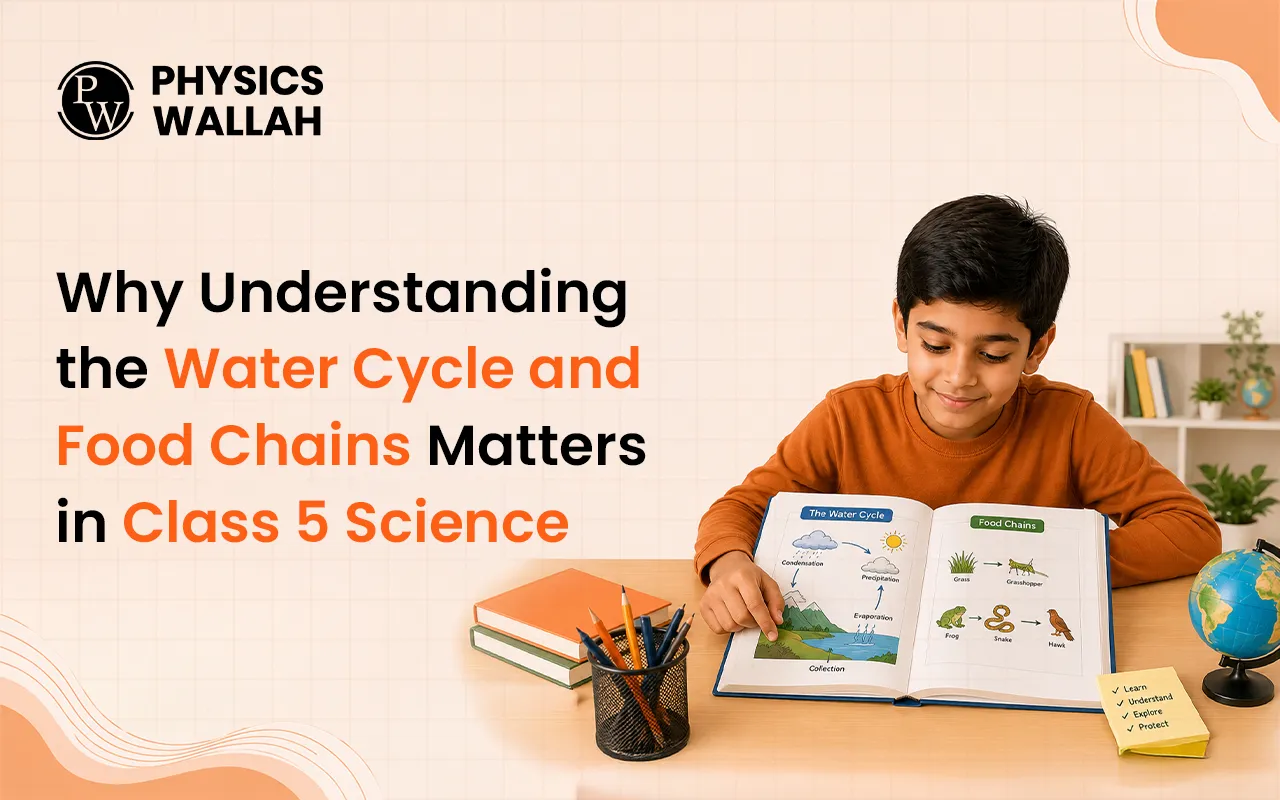
Why Students Find Water Cycle and Food Chain Class 5 Science Difficult
The fifth-grade environmental studies syllabus introduces systems that are entirely invisible to the naked eye. While a child can easily look at a dog or a plant, they cannot see water turning into invisible vapour. They also cannot see energy moving from a leaf to a caterpillar. This transition from visible items to abstract natural cycles creates a common learning hurdle for many children.
-
Rote Memorisation: Students often try to memorise definitions without understanding the actual scientific reasons behind them.
-
Confusing Terms: Primary school learners regularly mix up similar terms like evaporation, condensation, and transpiration.
-
Lack of Real-world Application: Children frequently fail to see how the food on their dinner plate connects back to the sun and wild habitats.
When young learners fail to understand these foundational systems, they often lose interest in higher-level biology and geography. Providing interactive tools helps kids learn these essential Class 5 science topics effortlessly. Breaking down complex processes into small, engaging fragments ensures children remain genuinely curious about the natural world.
How to Teach Water Cycle and Food Chain Class 5 Science Easily
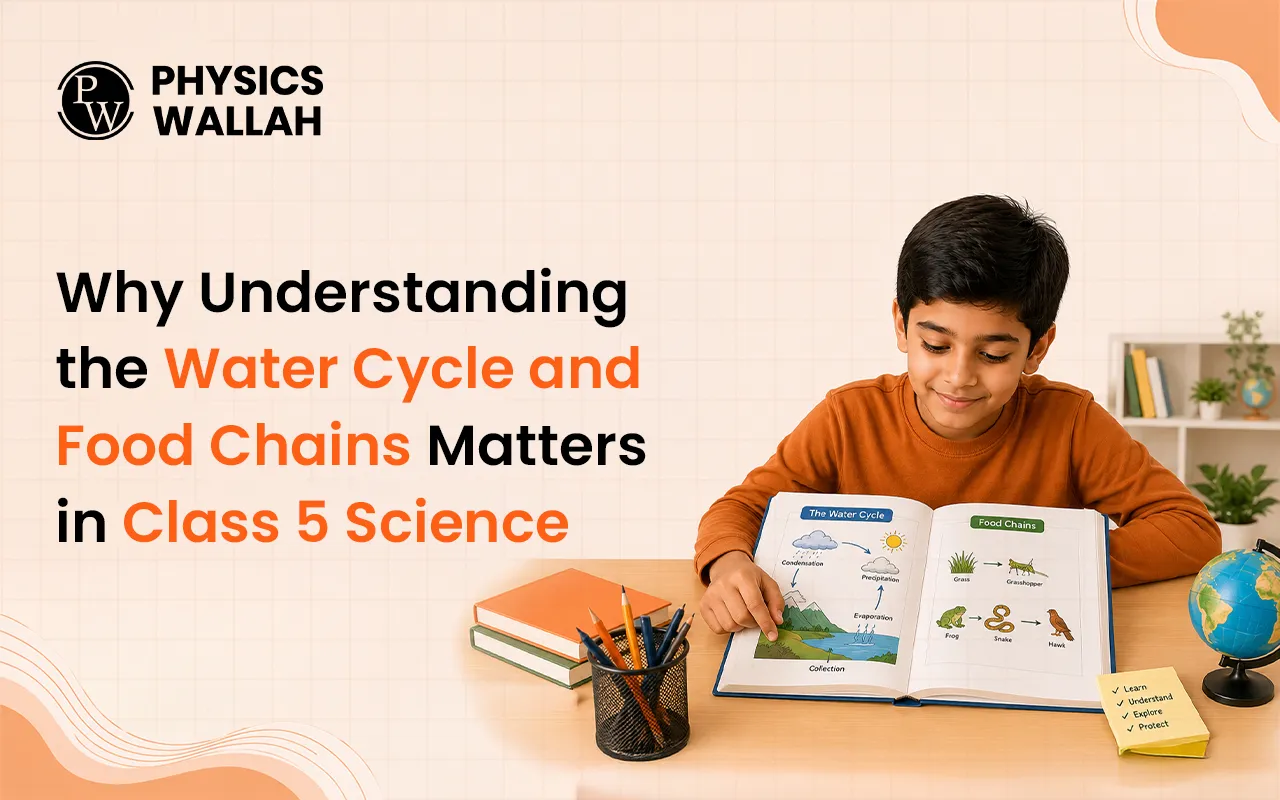
The water movement loop is the most vital natural cycle on Earth. Instead of forcing children to memorise thick textbook passages, parents and educators should explain it as a continuous planetary recycling adventure. To teach water cycle to kids class 5 effectively, you should break the entire process down into four distinct chronological steps:
1. Evaporation and Transpiration
The sun heats up the surface water found in rivers, oceans, lakes, and puddles. This liquid water warms up and transforms into an invisible gas called water vapour, which rises slowly into the sky. At the exact same time, plants release excess moisture through small pores in their green leaves. This plant-based moisture release is known as transpiration, and it contributes heavily to atmospheric moisture.
2. Condensation
As the warm water vapour rises higher into the sky, it encounters cooler air currents. When this invisible gas cools down, it transforms back into tiny liquid water droplets. These microscopic droplets gather together around dust particles floating in the air, creating clouds and mist.
3. Precipitation
Inside the clouds, water droplets constantly collide and merge into larger drops. Eventually, these water drops become too heavy to float in the sky. Gravity pulls them down toward the Earth as rain, snow, sleet, or hail, refilling our terrestrial water sources.
Read More - Is Your Class 5 Child Ready for the Challenges of Class 6? Here's How to Know
4. Collection
Once the falling rain hits the ground, it collects in various places. Some of it soaks deep into the soil to become groundwater, while the rest flows into rivers, lakes, and oceans. The sun heats this collected surface water again, starting the entire loop from the beginning.
|
Water Cycle Stage |
What Happens to Water? |
Real-world Example |
|
Evaporation |
Liquid turns into invisible gas |
Puddles drying up on a hot afternoon |
|
Transpiration |
Plants release moisture via leaves |
Forest areas feeling humid and damp |
|
Condensation |
Gas cools down into liquid |
Water droplets forming on a cold glass |
|
Precipitation |
Water falls back down to Earth |
Rainfall or winter snow showers |
|
Collection |
Water gathers in natural pools |
Streams flowing directly into lakes |
Food Chain Concepts in Water Cycle and Food Chain Class 5 Science
If the water system represents the moisture circulatory system of the Earth, then nutritional networks represent its energy highway. In a food chain Class 5 EVS lesson, students explore how every single living creature relies on other organisms for basic survival. This specific framework illustrates how energy moves across an ecosystem in a single direction.
Every basic food network contains three primary ecological categories:
-
The Producers: These are green plants that create their own organic food using sunlight, soil nutrients, water, and carbon dioxide through photosynthesis.
-
The Consumers: These are living creatures that cannot produce their own food. They must eat plants or other animals to gain energy. Consumers are further divided into herbivores (plant-eaters) and carnivores (meat-eaters).
-
The Decomposers: These are tiny organisms like fungi, earthworms, and bacteria. They break down dead plants and animals, returning vital minerals back to the soil for green plants to use again.
Without this continuous movement of nutritional energy, life on our planet would instantly stop. Fifth graders need to understand that deleting even one single animal or plant from this sequence throws the entire local environment into chaos.
How Natural Cycles Connect in Water Cycle and Food Chain Class 5 Science
True scientific understanding happens when a child stops looking at chapters as separate exam topics. In Class 5 environmental science, the water loop and biological feeding networks blend together perfectly. Plants require regular rainfall to grow and create food. Similarly, animals need to consume hydrated plants to get both moisture and nutritional energy.
When a forest experiences a severe drought due to a broken water cycle, the local plants wither and die. Because the green plants disappear, herbivores quickly starve, which eventually leaves carnivores without any food. This clear cause-and-effect relationship shows students how deeply natural systems depend on one another. Learning about this balance teaches children the importance of protecting wildlife, conserving water, and preserving the environment.
Read More - NCERT Solutions for Class 5 All Subjects 2026-27
Benefits of Learning Water Cycle and Food Chain Class 5 Science Through Online Tuition
As school textbooks become more advanced, classroom learning often needs to be supported at home. Enrolling a child in structured online science tuition Class 5 sessions offers several major benefits:
-
Learning at a Comfortable Pace: Children can review difficult lessons and rewind complicated explanations whenever they feel confused.
-
Personalised Educational Attention: Small online batches ensure that every student receives direct guidance tailored to their learning style.
-
Regular Progress Updates: Detailed monthly performance reports keep parents informed about their child's academic development and quiz scores.
-
Engaging Learning Environments: Fun educational games, rewards, and interactive quizzes keep young learners focused without screen fatigue.
Investing in high-quality online tuition early helps fifth graders build excellent study habits. Instead of panicking right before a school unit test, students learn to revise concepts consistently every day. This stress-free approach creates a solid foundation for more advanced subjects in higher classes.
How CuriousJr Makes Water Cycle and Food Chain Class 5 Science Easy
Traditional school classrooms often rely on repetitive text and memorisation, which can make science feel boring or confusing. CuriousJr online tuition for class 5 changes this approach completely by transforming complex textbook chapters into interactive, visual learning experiences. Aligned perfectly with major educational boards, the platform helps children learn difficult topics while enjoying their studies.
Parents can utilize structured resources to make after-school learning completely stress-free for fifth-grade students:
-
Interactive Live Sessions: Expert teachers explain scientific processes using live animations, clear models, and everyday examples.
-
The Two-Teacher Model: Every digital class features two dedicated educators. One teacher delivers the core lesson smoothly, while the second mentor answers student questions instantly.
-
Targeted Study Solutions: Students receive custom practice worksheets, interactive quizzes, and revision handouts to prepare for school exams.
-
Comprehensive Academic Support: Beyond science, children can access structured learning programs for Mathematics, English, and Social Studies.
Using visual tools and real-life examples helps young minds understand how nature functions. This conceptual clarity improves school exam scores and builds long-term critical thinking skills. Platforms like CuriousJr turn academic anxiety into authentic curiosity, helping kids complete their homework on time while building deep confidence in the classroom.





Why Understanding the Water Cycle and Food Chains Matters in Class 5 Science FAQs
Why do we study the water cycle and food chain Class 5 science chapters together?
What are the major stages of a Class 5 science water cycle?
How do decomposers help a food chain Class 5 EVS network stay healthy?
How can online science tuition Class 5 help my child score better in school exams?

Get Free Counselling Today
and Clear up all your Doubts
 Live & recorded classes available at easeDashboard for progress trackingLakhs of practice questions