
How to Tackle Class 9 Physics: Force, Motion, and Gravitation Explained Simply
 Nikita Aggarwal12 Jun, 2026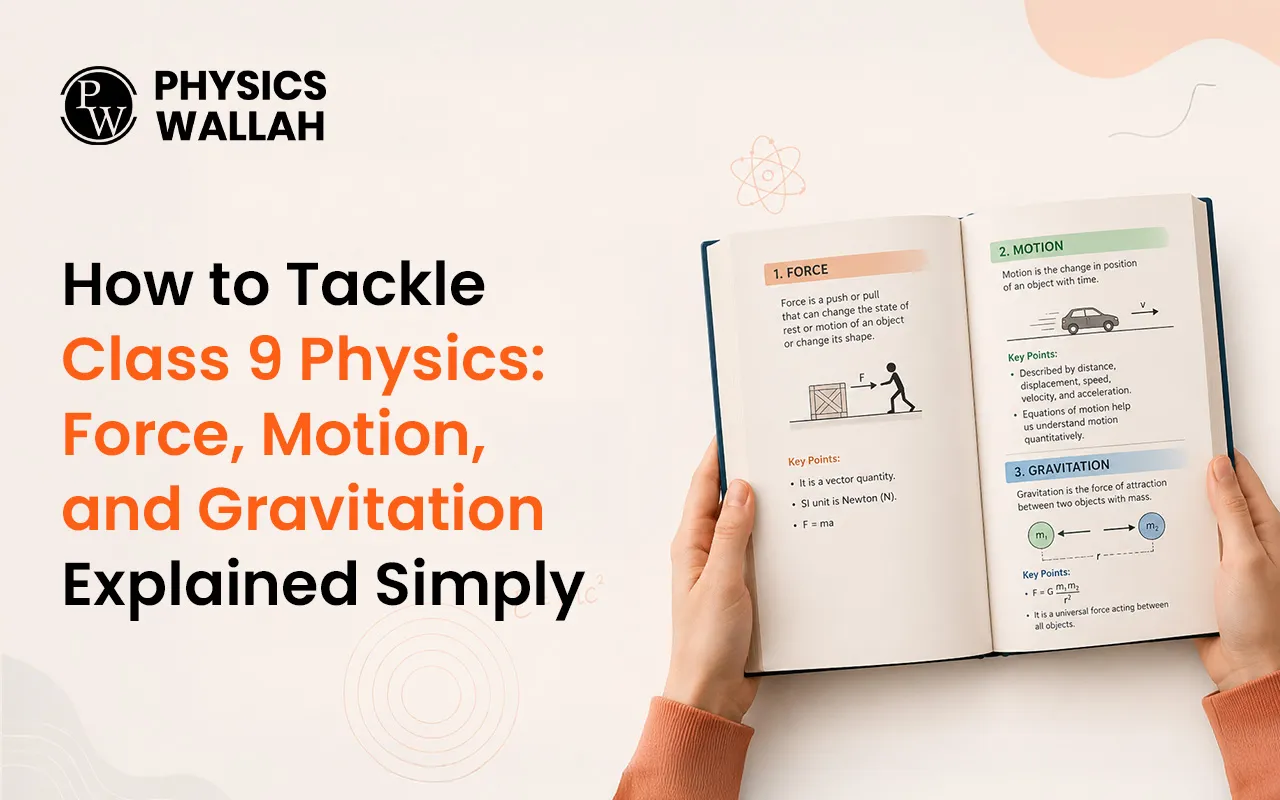
What Is Class 9 Physics Force Motion Gravitation?
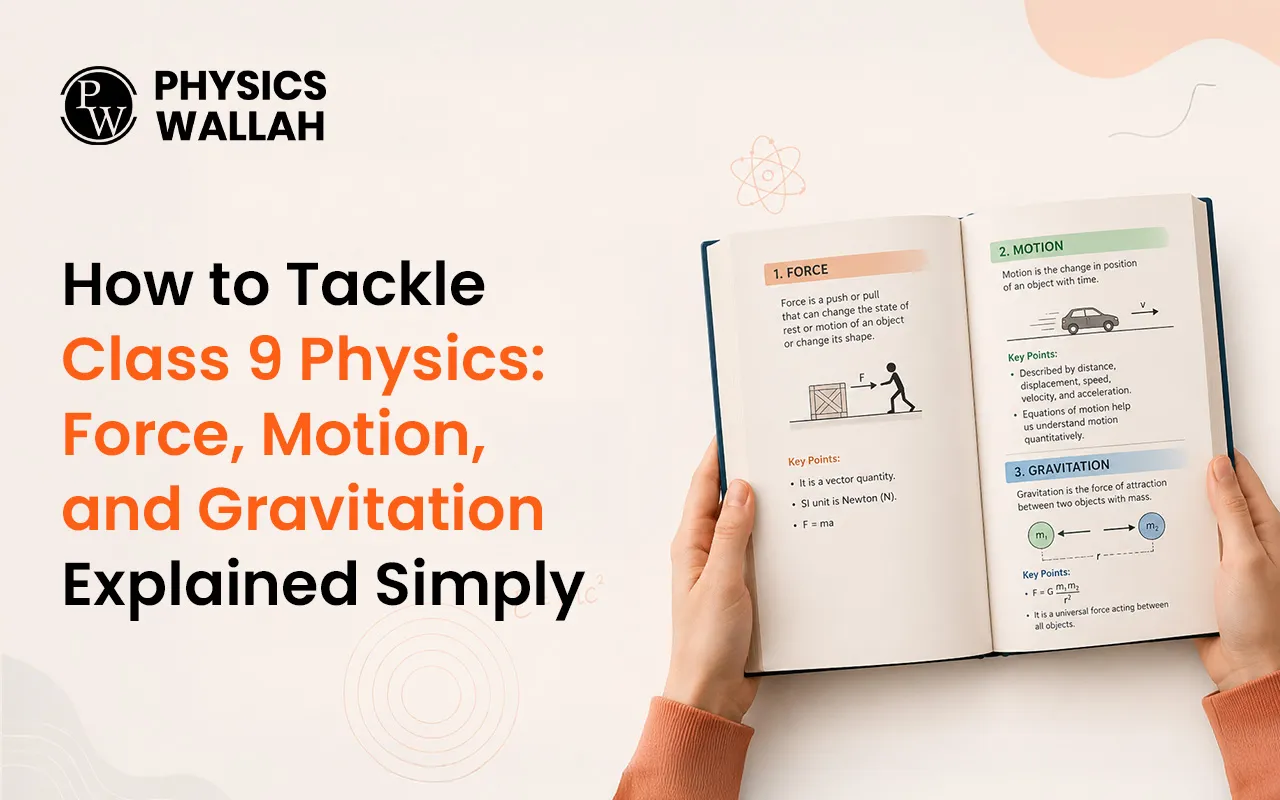
Physical science is the study of how things work (and move) in space. These interactions consist of three interrelated themes in the Class 9 physics concepts simplified:
-
Motion: The change in position of an object with time.
-
Force: A push or pull that changes this state of motion.
-
Gravitation: The universal force that pulls masses toward each other throughout the universe.
So, since we're going for Class 9 physics force motion gravitation structure that is as referral-ready and to-the-point in terms of chapters, let’s break down the concepts in the simplest way with direct references for how these concepts work.
1. Force and the Laws of Motion
A force is an influence that tends to change the motion of an object, either by acceleration or deceleration. In the real world, forces can change the speed of an object, stop a moving body, and set something in motion from rest. A force can change the direction of motion for an enormous effect, slowing down or even bending and moving the shape & size denoted by the figure. Thus, Principles of force and motion Class 9, tells us that nothing can move or come to rest without interaction.
Forces are broadly categorised into two fundamental types:
-
Contact Forces: These arise from physical contact between two objects. Muscular force (need to push heavy door) and frictional force for walking or driving, friction acts as opposing surface resistance.
-
Non-Contact Forces: They act over a distance without the need for direct contact. Examples are gravitational force (the downward pull from the Earth on an object), electrostatic force, and magnetic force.
Forces can act on an object in one of only two ways when a body is subjected to multiple forces.
-
Balanced Forces: The net or resultant force is zero. These two forces act on the object and by so doing cancel each other out, leaving no change to its current state of rest or uniform motion. For example, a book resting on a table.
-
Unbalanced Forces: This asymmetry breaks the object's inertia, directly resulting in an acceleration. For example, a car moves forward because the push from the engine is greater than air resistance + friction.
Among these behaviours, Sir Isaac Newton formalised three fundamental laws:
-
Newton's First Law (Law of Inertia): An object that is at rest stays in a state if the body will remain stationary unless an unbalanced external force acts on it an object remains at rest or in uniform motion unless acted upon by an external force. Inertia is just a property of an object to remain in the same state it was in until an external force acts on it.
-
Newton's Second Law: The momentum change of an object is directly proportional to the unbalanced force acting on it and takes place in the same direction as that applied. This leads to the famous relationship of force as a function of mass times acceleration: F = ma.
-
Newton's Third Law: For every action there is always an equal and opposite reaction. For example, if an apple falls from the tree, it pulls the Earth as much as the Earth pulls towards that apple. That being said, the mass of Earth itself is unimaginably large, making its resulting acceleration small to human perception.
2. Gravitation and the Universal Law
This inevitably led Newton from observing Earth to an understanding and observation that every mass in our universe is actually attracted to every other mass. Gravitation Class 9 explained that you understand that this very force which holds your feet to the ground also keeps planets in orbit.
An object following circular motion changes direction throughout its path, so the velocity is changing at every point of this motion. The centripetal force is the component of a net or resultant force that keeps an object moving along this circular path, pulling it towards its centre. Otherwise, our objects would all suddenly move in a straight line. One example is the Moon, which stays in constant orbit of Earth all thanks to centripetal force from Earth's gravity.
According to Newton's Universal Law of Gravitation, the attraction between two different masses is
-
It is directly proportional to the masses of both objects.
-
Inversely proportional to the square distance between their centres.
Mathematically, this relationship is expressed as:
F = G * (m1 * m2) / r^2
Where:
-
F is the total gravitational force between the objects.
-
m1 and m2 are the masses of the two objects that are interacting.
-
r is the straight-line distance between their centres.
-
G is the universal gravitational constant. Its value is the same across the whole universe and was measured as 6.67 × 10⁻¹¹ N. m² kg² by Henry Cavendish.
Read More - Why Concept-Based Learning in Class 9 Matters More Than Rote Memorisation
3. Acceleration Due to Gravity and Free Fall
Free fall is a condition in which an object moves toward the Earth only under the influence of gravitational pull. In a true free fall scenario, the body is not subject to any secondary forces like air resistance. When it lands, the object appears to fall with constant acceleration. that of g (lowercase letter).
g at the surface of Earth is ~ 9.8 m/s². The Earth is not a perfect sphere but instead flattens at the poles, which bulges at the equator, meaning that the distance to the surface from outer space (to the centre) is less around the south and north poles. As a result, the value of g is comparatively high at the poles and low at the equator.
Generally, the equations of motion are linear for uniform acceleration objects, but instead we replace our variable 'a' (acceleration) in these standard terms with 'g' (gravitational acceleration):
-
When an object falls freely from rest (initial velocity u = 0):
-
v = gt
-
s = 0.5 * gt^2
-
v^2 = 2gs
-
When an object is thrown vertically upward: Gravity acts in the opposite direction of motion, making the value of g negative.
-
v = u - gt
-
s = ut - 0.5 * gt^2
-
v^2 = u^2 - 2gs
Read More - How to Prepare for Class 10 Board Exams Starting From Class 9 Itself
5. Thrust, Pressure, and Fluid Mechanics
Completing your understanding of curriculum details requires that you understand how forces act on surfaces and inside fluids:
-
Thrust: The force acting perpendicular to a surface of an object. It is a vector quantity, measured in Newtons.
-
Pressure: The total perpendicular thrust acting on a unit area of a surface (Pressure = Thrust / Area). The standard SI unit is newtons per metre squared (N m⁻²), which is also named the pascal (Pa).
Decreasing the contact area spikes pressure since it is inversely proportional to area. This is also why iron nails are produced with very sharp points; a smaller surface area means greater pressure applied to the wall, which helps it penetrate through smoothly.
Fluids (liquids and gases) have weight, exerting pressure on the base and walls of any container holding them. When an object is placed in a liquid, the fluid pushes back up against it with a force that counteracts gravity. This upwards force is known as the buoyant force or upthrust.
-
Sinking: An object will sink if its downwards gravitational force is greater than the upwards buoyant force (its overall density being larger means it sinks).
-
Floating: A body floats when the upward buoyant force is equal to or greater than its downward object weight (its overall density being less than that of fluid).
How CuriousJr Helps You Learn Class 9 Physics Force Motion Gravitation
Shifting to a dedicated online tuition class for 9th physics can change the course of your academics when school lessons go too fast. The best thing about an all-inclusive Class 9 science online class is the guidance it offers in turning our confusions into true comprehension of academic subject matter.
Using platforms tailored around a particular school curriculum requirement, such as Curious Jr, students are found to get access to Class 9 physics help at their immediate disposal.
-
Expert-Led Interactive Classes: Difficult concepts get simplified via step-by-step tutorials with relatable and tangible contrivances for visualising abstract statutory provisions.
-
On-Demand Doubt Resolution: Instructors are available to provide regular doubt-solving support with difficult numerical problems and conceptual hurdles, both during live sessions and during offline doubt-clearing periods.
-
Comprehensive Practice Materials: Precise revision notes, auxiliary quizzes and focused worksheets help students start developing speed & accuracy from the comfort of home.
By using these engaging learning environments, it helps students stay consistent during preparation and rehearsing what to revise so that when entering the exam hall, you own it.





How to Tackle Class 9 Physics: Force, Motion, and Gravitation Explained Simply FAQs
What is the main difference between balanced and unbalanced forces?
Why does the value of acceleration due to gravity (g) vary across the Earth?
How does a Class 9 physics online tuition class help with numerical problems?

Get Free Counselling Today
and Clear up all your Doubts
 Live & recorded classes available at easeDashboard for progress trackingLakhs of practice questions