Compass Drawing: Steps to Draw and Tips to Remember
 Nivedita Dar19 Feb, 2026

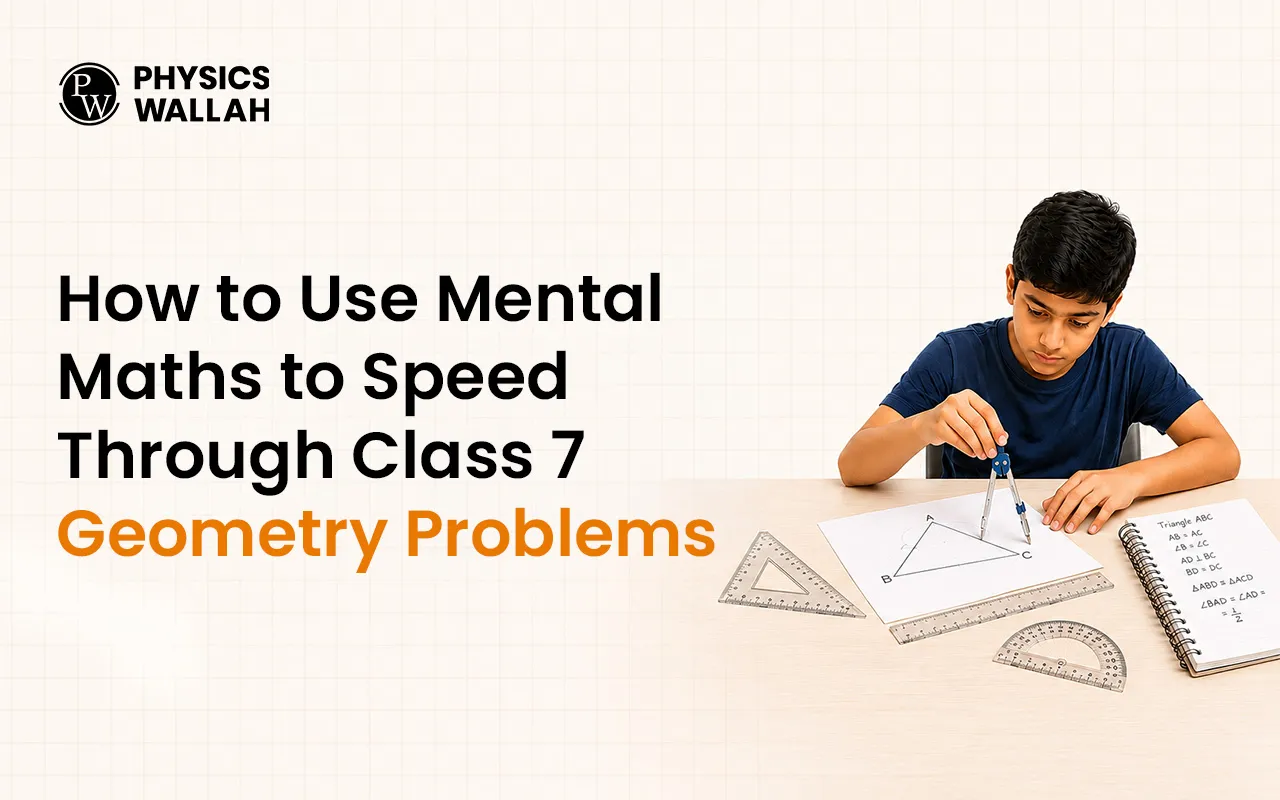
Have you ever tried to draw a perfect circle without using a ruler? It usually ends up looking more like a potato or a lopsided egg. This is a common struggle for students starting out in geometry. You need to learn how to use a compass to draw in order to have that clean, professional look in your maths notebook. A compass is not just useful for explorers; it is also the most accurate tool in maths. Knowing how to compass drawing to draw circles is a basic skill that makes maths a lot easier and more fun. It doesn't matter if you're working on a simple school project or a complicated geometric pattern.
What Does Compass Drawing Mean?
Before we get into the processes of sketching a compass, let's first make sure we know what is meant by "compass" in maths. A compass is a V-shaped tool used in geometry to make precise circles or circular arcs. It is also useful for measuring distances on maps or along a line segment.
A compass is different from a ruler because it can manage curves. It works by keeping the radius the same, which means that every point on the edge of your circle is the same distance from the centre.
What are the Parts of a Compass?
You need to know how the compass works in order to achieve the greatest results with your artwork. There are a few main parts that make up most common compasses:
-
The Handle: This is the little knob at the top. This is where you should hold the compass with your thumb and index finger.
-
The Legs: There are two "legs" that are joined by a hinge. One leg holds the pencil, and the other holds the needle.
-
The Needle Point: This is the sharp metal tip. It acts as the centre point of your circle and must stay fixed on the paper.
-
The Pencil Lead/Holder: This is what holds the graphite that makes the line.
-
The Hinge/Adjustment Nut: This allows you to change the distance between the two legs, which determines the size of your circle.
Professionals typically use a large drawing compass or a large compass drawing tool for major projects on a whiteboard or large charts. These tools work on the same principles but are much larger.
A Step-by-Step Guide to Compass Drawing
To get good at drawing with a compass, you need to be patient and have a steady hand. To make a flawless circle every time, do the following:
Step 1: Prepare Your Pencil
Make sure your pencil is sharp. If you use a dull pencil, the lines will be thick and wrong. Put the pencil in the holder and make sure the tip of the pencil is level with the metal needle point when the compass is closed. Tighten the screw so the pencil stays still.
Step 2: Set the Radius
The distance from the centre of the circle to its periphery is called the radius. Set this distance with a ruler. Put the needle on the "0" mark and open the compass leg until the pencil tip reaches the measurement you want (for example, 5 cm).
Step 3: Position the Needle
Place your paper on a flat surface. It helps to have a few extra sheets of paper underneath to allow the needle to grip better. Place the needle point firmly at the spot where you want the centre of your circle to be.
Step 4: The Rotation
Hold the compass by the handle at the top. Lean the compass slightly in the direction you are drawing. In one smooth motion, rotate the pencil leg around the needle. Try to complete the circle in one go without lifting the needle.
Read More - Ordinal Numbers: Definition, Examples, and Uses in Mathematics
Tips for Perfect Compass Drawing
You might still get some "wobbly" circles, even if you do everything perfectly. Here are some helpful ideas to keep in mind:
-
Don't Press Too Hard: If you push down too hard on the pencil leg, the hinge can open up, which would change the size of your circle halfway through.
-
Keep the Needle Still: The most common mistake is to let the needle slip. Don't put pressure on the pencil leg; keep it on the needle leg.
-
Check the Tightness: If the legs of your compass are loose, use a screwdriver to tighten the hinge. A compass that isn't tight will never draw a circle that is always the same.
-
Paper Choice: Avoid drawing on very thin paper. A large compass drawing tool specifically requires a sturdy surface because the needle point is often thicker.
Read More - Constants in Maths - Definition, Formula, Examples
Why Do We Use Compass Drawing?
You might wonder why we don't just trace a coin or a bottle cap. Tracing works for small circles, but a compass for drawing circles is more flexible. You can use a large drawing compass to make a circle of any size, from a tiny 1 cm radius to a massive arc. Also, compasses are very important for. Furthermore, compasses are essential for:
-
Constructing Angles: You can bisect angles or create 60-degree angles without a protractor.
-
Creating Patterns: A compass is very important for making mandalas and geometric art.
-
Triangles: Finding the third vertex with arcs makes it much easier to draw equilateral triangles.
Summary of Best Practices of Compass Drawing
Let’s revise the best practices of compass drawing for a better outcome:
|
Action |
Why it Matters |
|
Align Tips |
Ensures the circle starts and ends at the same point. |
|
Sharpen Lead |
Keeps the circumference line thin and accurate. |
|
Hold Handle |
Prevents your fingers from accidentally changing the radius. |
|
Use Padding |
Gives the needle a "grip" so it doesn't slide across the desk. |
Using a compass is a rite of passage for every geometry student. Once you get the hang of the "pivot and rotate" motion, you will find that compass drawing is one of the most satisfying parts of your maths kit.
Strengthen Your Child’s Maths Speed and Confidence with CuriousJr’s Mental Maths Course
CuriousJr’s Mental Maths Course helps children improve their number skills and calculate faster with accuracy. The course follows a simple, step-by-step method that makes learning maths clear, easy, and enjoyable.
Students learn key operations such as addition, subtraction, multiplication, and division. The program focuses on both speed and correctness. Fun activities, interactive sessions, and regular practice help improve problem-solving skills and build a strong foundation in maths.
With friendly guidance and structured lessons, CuriousJr helps children overcome their fear of maths and develop confidence. This course is ideal for school students who want to improve their daily maths performance and feel comfortable working with numbers.