

Auxiliary Verbs: Types, List, Rules and Examples
 Jasdeep Singh28 Sept, 2026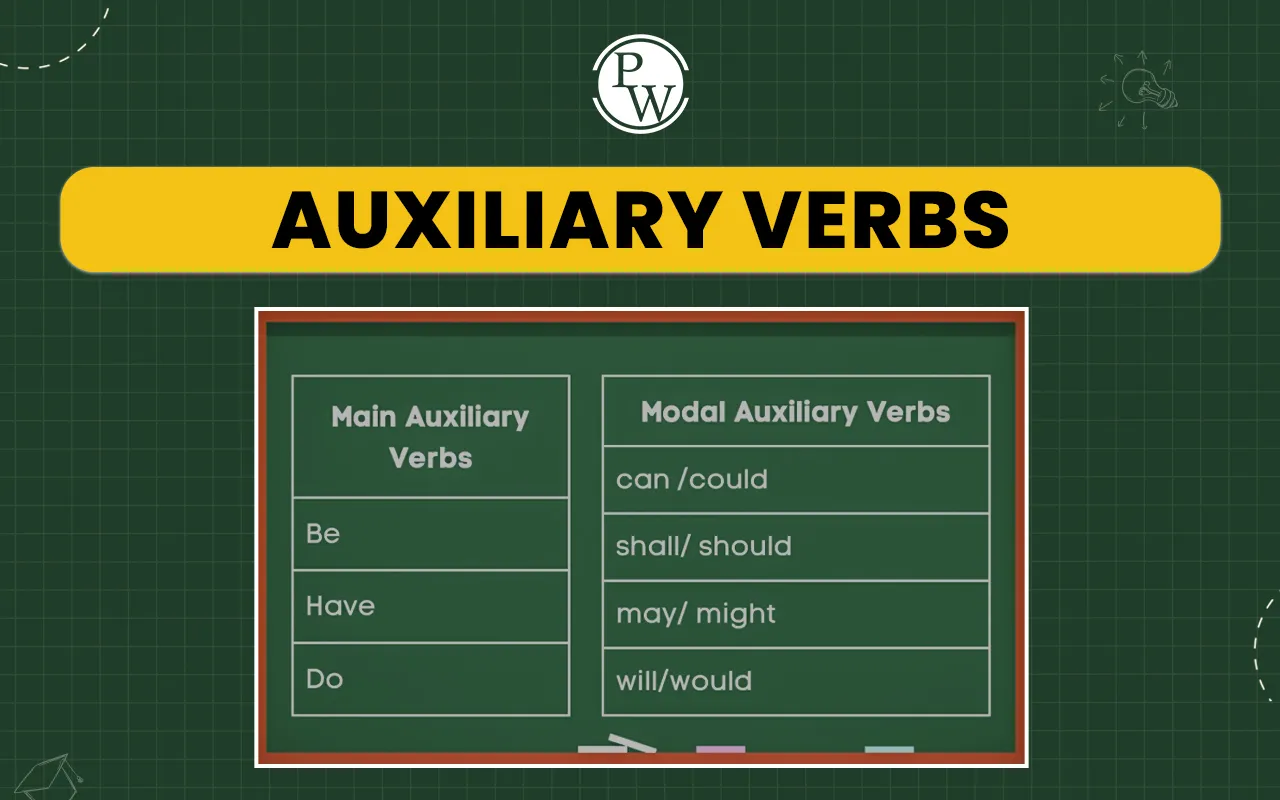
What Is an Auxiliary Verb?
An auxiliary verb is a verb that helps the main verb express information such as tense, aspect, voice, questions, negatives, possibility, ability, permission, obligation or necessity.
Auxiliary verbs are also called helping verbs.
Common auxiliary verbs include:
be, am, is, are, was, were, being, been, have, has, had, do, does, did, will, can, could, may, might, must, shall, should and would.
Examples:
-
She is reading a book.
-
They have finished their work.
-
Do you like football?
-
He can swim.
-
We will visit the museum.
In these examples, the auxiliary verb helps form the tense or express a particular meaning.
Simple Definition of Auxiliary Verb
An auxiliary verb is a helping verb used with another verb to form a grammatical verb phrase or express meanings such as tense, aspect, voice, possibility or obligation.
Also, check: Class 7 English Grammar Worksheet on Modal Verbs
Auxiliary Verb Meaning
The word auxiliary means something that provides help or support.
In English grammar, an auxiliary verb helps another verb. For example:
She is singing.
Here:
-
is = auxiliary verb
-
singing = main verb
The auxiliary is helps show that the action is in progress.
Auxiliary Verb List
Here is a useful list of English auxiliary verbs.
| Auxiliary Verb | Common Use |
| am | present forms of be |
| is | present forms of be |
| are | present forms of be |
| was | past forms of be |
| were | past forms of be |
| be | forms of be |
| being | continuous/passive forms |
| been | perfect/passive forms |
| have | perfect forms |
| has | perfect forms |
| had | past perfect forms |
| do | questions, negatives, emphasis |
| does | questions, negatives, emphasis |
| did | past questions, negatives, emphasis |
| will | future/reference to future |
| would | conditional, polite requests, reported speech |
| shall | suggestions or formal future reference |
| should | advice, expectation, obligation |
| can | ability, possibility, permission |
| could | past ability, possibility, polite requests |
| may | permission, possibility |
| might | possibility |
| must | necessity or strong obligation |
The exact function of an auxiliary depends on the sentence.
Also, check: Interrogative Sentence – Definition, Meaning, Types & 10+ Examples
Types of Auxiliary Verbs
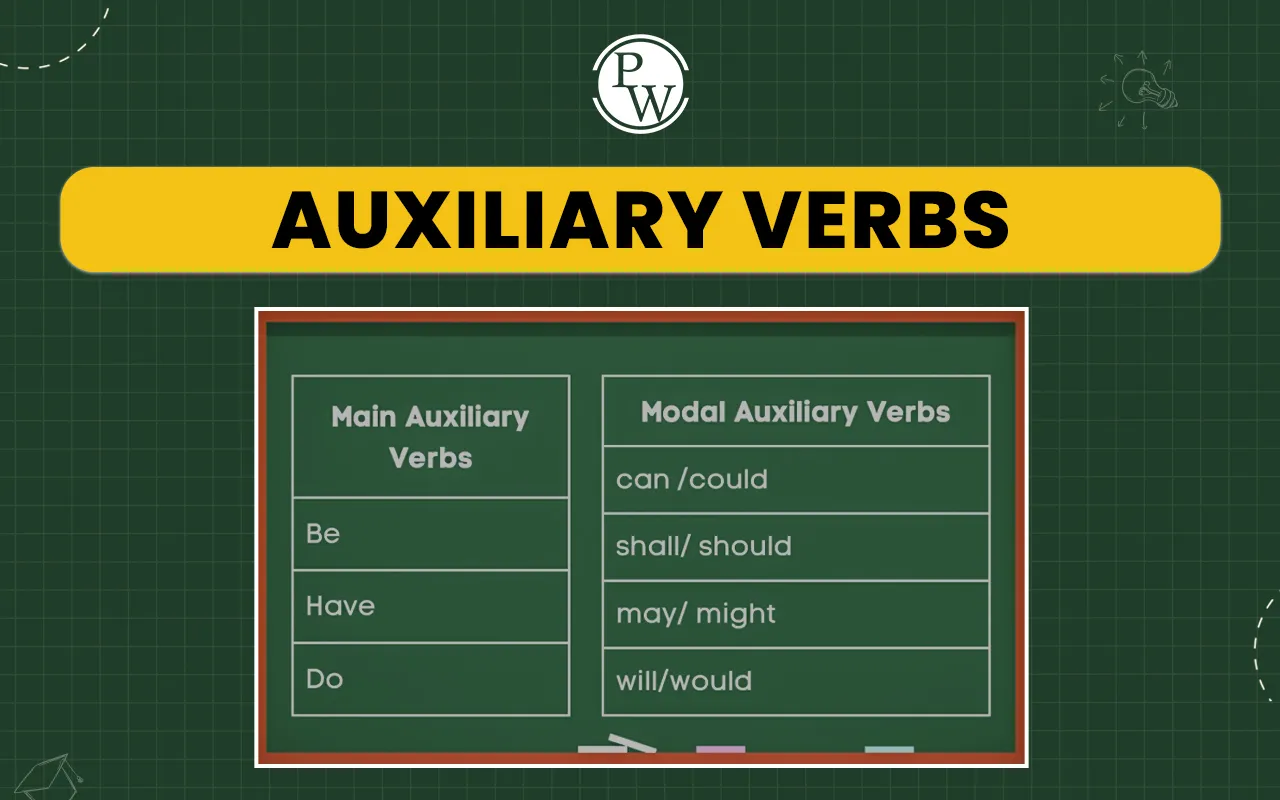
Auxiliary verbs are commonly divided into two major groups:
-
Primary auxiliary verbs
-
Modal auxiliary verbs
There is also a special category called semi-modal verbs in some grammar systems, but the two groups above are the main school-level classification.
1. Primary Auxiliary Verbs
The three primary auxiliary verbs are:
-
Be
-
Have
-
Do
Their forms include:
Forms of Be
am, is, are, was, were, be, being, been
Examples:
-
I am studying.
-
She is writing.
-
They are playing.
-
He was sleeping.
-
We were waiting.
The verb be is used to form continuous tenses and passive constructions.
Forms of Have
have, has, had
Examples:
-
I have finished my homework.
-
She has completed the project.
-
They had left before we arrived.
The verb have is used to form perfect constructions.
Forms of Do
do, does, did
Examples:
-
Do you like music?
-
Does he play cricket?
-
Did they finish the work?
Do, does and did are commonly used to form questions and negative sentences with ordinary verbs.
Primary Auxiliary Verbs Chart
| Primary Auxiliary | Forms | Common Uses | Example |
| Be | am, is, are, was, were, be, being, been | Continuous forms, passive voice | She is reading. |
| Have | have, has, had | Perfect constructions | They have finished. |
| Do | do, does, did | Questions, negatives, emphasis | Do you agree? |
2. Modal Auxiliary Verbs
Modal auxiliary verbs express meanings such as ability, possibility, permission, advice, necessity, obligation or prediction.
Common modal auxiliaries include:
can, could, may, might, must, shall, should, will and would.
Examples:
-
She can swim.
-
It might rain.
-
You should study.
-
We must follow the rules.
-
May I come in?
-
They will arrive tomorrow.
Modal Auxiliary Verb Chart
| Modal | Common Meaning | Example |
| can | ability, permission, possibility | I can swim. |
| could | past ability, possibility, polite request | Could you help me? |
| may | permission, possibility | May I enter? |
| might | possibility | It might rain. |
| must | necessity, strong obligation | You must wear a helmet. |
| shall | suggestion or formal future reference | Shall we begin? |
| should | advice, expectation | You should rest. |
| will | future, willingness | I will help you. |
| would | polite request, conditional meaning | Would you like some tea? |
Auxiliary Verbs Chart
Here is a quick chart for revision:
| Type | Auxiliary Verbs | Example |
| Primary: Be | am, is, are, was, were, be, being, been | She is singing. |
| Primary: Have | have, has, had | She has finished. |
| Primary: Do | do, does, did | Do you know him? |
| Modal | can, could, may, might, must, shall, should, will, would | You should study. |
Auxiliary Verb Examples
Here are some common auxiliary verb examples:
-
I am reading a book.
-
She is cooking dinner.
-
They are playing outside.
-
He was watching television.
-
We were waiting for the bus.
-
She has finished her homework.
-
They have completed the project.
-
He had left before I arrived.
-
Do you like apples?
-
Does she speak English?
-
Did they call you?
-
You can solve this problem.
-
We should help others.
-
It may rain today.
-
You must follow the instructions.
Auxiliary Verb Examples in Sentences
Be as an Auxiliary
-
I am learning English.
-
She is dancing.
-
They are playing football.
-
He was sleeping.
-
We were studying.
Have as an Auxiliary
-
I have completed my work.
-
She has eaten lunch.
-
They had finished the test before the bell rang.
Do as an Auxiliary
-
Do you know the answer?
-
Does he play chess?
-
Did she visit the library?
Modal Auxiliaries
-
I can help you.
-
You could try again.
-
It may rain.
-
He might come later.
-
You must wear your uniform.
-
You should listen carefully.
-
We will meet tomorrow.
-
Would you like some water?
Uses of Auxiliary Verbs
Auxiliary verbs perform several important functions in English grammar.
1. Showing Continuous Actions
Forms of be are used with the present participle to form continuous constructions.
Examples:
-
She is reading.
-
They are playing.
-
He was sleeping.
-
We were talking.
2. Forming Perfect Constructions
Forms of have are used with a past participle.
Examples:
-
I have finished my work.
-
She has completed the task.
-
They had left before we arrived.
3. Forming Questions
Auxiliary verbs are especially important when forming questions.
Do, does and did are commonly used to form questions with ordinary verbs.
Examples:
-
Do you like chocolate?
-
Does he play cricket?
-
Did they visit the museum?
Auxiliary verbs also come before the subject in many questions.
Example:
She is ready.
Is she ready?
4. Forming Negative Sentences
Auxiliary verbs can be used with not to make negative constructions.
Examples:
-
She is not sleeping.
-
They are not ready.
-
I do not know.
-
He does not agree.
-
We did not go.
-
You cannot enter.
5. Showing Ability
Modal auxiliaries can express ability.
Examples:
-
She can swim.
-
He can speak French.
-
I could ride a bicycle when I was five.
6. Showing Possibility
Examples:
-
It may rain today.
-
She might come later.
-
This could be the answer.
7. Showing Permission
Examples:
-
May I come in?
-
Can I use your pencil?
-
Could I borrow your book?
8. Showing Advice
Should is commonly used to give advice.
Examples:
-
You should study regularly.
-
We should help people in need.
-
You should drink enough water.
9. Showing Necessity or Obligation
Must can express strong necessity or obligation.
Examples:
-
You must wear a seat belt.
-
Students must follow the school rules.
Students can strengthen their English grammar skills through interactive learning resources on CuriousJr.
Auxiliary Verb Rules
Rule 1: Auxiliary Verbs Help Form Verb Phrases
Example:
She is singing.
Here, is helps the main verb singing.
Rule 2: Use Do, Does and Did Correctly
Use:
-
do with I, you, we and they
-
does with he, she and it
-
did for the past tense with all subjects
Examples:
-
Do you play?
-
Does she play?
-
Did they play?
Rule 3: Use the Base Verb After Do, Does and Did
Correct:
-
Does he play cricket?
-
Did she finish her homework?
Incorrect:
-
Does he plays cricket?
-
Did she finished her homework?
Rule 4: Modal Auxiliaries Are Followed by the Base Form
Examples:
-
She can sing.
-
You should study.
-
They will come.
-
He must leave.
Not:
-
She can sings.
-
You should studied.
-
They will came.
Rule 5: Do Not Use Two Modals Together in Standard English
Incorrect:
He will can come.
Better:
He will be able to come.
Rule 6: Negative Forms Usually Use Not
Examples:
-
is not
-
are not
-
has not
-
do not
-
cannot
-
should not
-
will not
Examples:
-
She is not ready.
-
They do not agree.
-
You should not worry.
Auxiliary Verb vs Main Verb
An important point is that auxiliary verbs can sometimes also function as main verbs.
Compare:
She is running.
Here, is is an auxiliary verb because it helps running.
She is happy.
Here, is is the main verb, linking the subject she to the adjective happy.
Similarly:
They have finished the work.
Here, have is an auxiliary.
They have a car.
Here, have is the main verb showing possession.
The role of a verb depends on how it is used in the sentence.
Auxiliary Verb vs Helping Verb
Auxiliary verb and helping verb generally refer to the same grammatical idea.
For example:
She is reading.
-
is = auxiliary verb
-
is = helping verb
-
reading = main verb
“Helping verb” is often used in school grammar because it makes the function easy to understand.
Auxiliary Verb vs Modal Verb
Modal verbs are a type of auxiliary verb.
For example:
-
can
-
could
-
may
-
might
-
must
-
should
-
will
-
would
So:
All modal auxiliaries are auxiliary verbs, but not all auxiliary verbs are modal verbs.
For example, is is an auxiliary verb but not a modal auxiliary.
How Auxiliary Verbs Change Questions
Auxiliary verbs are especially important when forming questions.
Statement
She is reading.
Question
Is she reading?
The auxiliary is moves before the subject.
With an ordinary verb:
Statement
She likes music.
Question
Does she like music?
Here, does is added, and likes changes to the base form like.
Auxiliary Verbs in Negative Sentences
Compare these examples:
| Positive | Negative |
| She is working. | She is not working. |
| They are ready. | They are not ready. |
| He has finished. | He has not finished. |
| I like tea. | I do not like tea. |
| She likes tea. | She does not like tea. |
| They went home. | They did not go home. |
| You can swim. | You cannot swim. |
| We should leave. | We should not leave. |
Notice that do, does and did are needed with ordinary verbs when forming negatives in the simple present and simple past.
Auxiliary Verbs and Tense
Auxiliary verbs help form several common tense constructions.
| Construction | Auxiliary | Example |
| Present continuous | am/is/are | She is reading. |
| Past continuous | was/were | They were playing. |
| Present perfect | have/has | He has finished. |
| Past perfect | had | She had left. |
| Future | will | They will arrive. |
The exact tense system is larger than this table, but these examples show how auxiliary verbs help express time and aspect.
Common Auxiliary Verb Mistakes
Mistake 1: Using the Wrong Form of Be
Wrong: She are reading.
Correct: She is reading.
Mistake 2: Using Does With a Past Verb
Wrong: Does he went to school?
Correct: Does he go to school?
Mistake 3: Using Did With the Past Form
Wrong: Did she ate lunch?
Correct: Did she eat lunch?
Mistake 4: Adding -s After a Modal
Wrong: He can sings.
Correct: He can sing.
Mistake 5: Using an Unnecessary Do With a Modal
Wrong: Do you can swim?
Correct: Can you swim?
Auxiliary Verb Practice Questions
A. Fill in the Blanks
Choose the correct auxiliary verb.
-
She ___ reading a book.
-
They ___ finished their homework.
-
___ you like mangoes?
-
___ he play football?
-
We ___ going to school.
-
You ___ follow the rules.
-
___ she completed the project?
-
I ___ not understand the question.
-
He ___ swim very well.
-
They ___ arrive tomorrow.
Answers
-
is
-
have
-
Do
-
Does
-
are
-
must/should, depending on the intended meaning
-
Has
-
do
-
can
-
will
B. Identify the Auxiliary Verb
-
She is singing.
-
They have finished the work.
-
Do you know him?
-
We can help you.
-
He was sleeping.
Answers
-
is
-
have
-
do
-
can
-
was
Quick Revision
-
Auxiliary verbs are also called helping verbs.
-
The main groups are primary auxiliaries and modal auxiliaries.
-
The primary auxiliaries are be, have and do.
-
Forms of be include am, is, are, was, were, being and been.
-
Forms of have include have, has and had.
-
Forms of do include do, does and did.
-
Common modal auxiliaries include can, could, may, might, must, shall, should, will and would.
-
Auxiliary verbs help form questions, negatives, tenses, aspects and passive constructions.
-
Modal auxiliaries can express ability, possibility, permission, advice and necessity.
-
After do, does and did, use the base form of the main verb.
-
After a modal auxiliary, use the base form of the verb.
-
An auxiliary verb can sometimes function as the main verb, depending on the sentence.



